
Written 24 September 2026 (AEST). On online identity, the innovation personas, and why the most useful thing a founder can build is a voice that is not his own.
I. An icebreaker, fifteen years late
On 30 April 2011, the first creative piece I ever published on this site was a short story.
It opens with a software engineer at a place called The Company, decrypting maintenance codes on a wet morning, exhausted, watched by a manager called Dell. He receives an email from a colleague. He decrypts it against every rule he has been given. He discovers that the defence system he has been helping to build — Maximus — has been turned around and pointed back at the world, and that the people who did it sit above his manager and answer only to the Board.
The narrator is not me. I have never worked at The Company. There is no Maximus. I was not there.
The piece was called An Icebreaker — Read Between The Lines.
I did not know it at the time, but that title was the whole thesis of the next fifteen years. The first thing I ever did in public was write in a voice that was not mine, and then tell you, in the title, exactly how to read it.
Everything below is a long footnote to that instruction.
II. The devil’s advocate, and the company he keeps
In November 2018 I wrote a piece called Destroyer or Creator: Juxtaposing the Devil’s Advocate against the Cross-Pollinator. I was unkind about the devil’s advocate. I called him an archetype destroyer of faith and suggested that when someone announces they are about to play the role, the correct response is to leave the room.
That framing was not original to me. It comes from Tom Kelley of IDEO, whose book The Ten Faces of Innovation (2005) opens with the argument that the devil’s advocate may be the single most effective innovation killer in modern organisations — precisely because the phrase grants its user the licence of a role while requiring none of the accountability of a position. You do not have to believe what you are saying. You merely have to say it, and the idea dies.
Kelley’s answer was not to argue back. It was to crowd the devil out with better personas. Ten of them, grouped in three families:
- Learning — the Anthropologist, the Experimenter, the Cross-Pollinator
- Organising — the Hurdler, the Collaborator, the Director
- Building — the Experience Architect, the Set Designer, the Caregiver, the Storyteller
The insight that has stayed with me for eight years is structural rather than motivational. Kelley is not describing ten personality types, and he is not telling you to find the one you are. He is describing ten roles a single person can occupy, deliberately, at different moments, for different purposes — none of which is a claim about who that person is.
The Cross-Pollinator draws associations between unrelated fields. The Anthropologist watches without judging. The Caregiver anticipates need. These are not confessions. They are instruments. And an instrument’s reading is not a statement about the mood of whoever built it.
That distinction is the one the internet has almost entirely lost.
III. What the internet did to the mask
Every culture has understood the difference between a person and the role they occupy. The Greek persona was literally the mask, and nobody watching a tragedy believed they were watching the actor’s private life. The judge in robes is not being personally punitive. The surgeon is not being personally violent. The role carries authority precisely because everyone agrees it is a role.
Then we moved the whole apparatus onto platforms built around a single, flattening assumption: that an account is a person, and that everything posted from it is autobiography.
This assumption is so deeply embedded that it is nearly invisible. We read a market call as a confession of temperament. We read an argument as a declaration of character. We read a body of work produced over fifteen years across four disciplines and we try to resolve it into a single consistent human being — and when it will not resolve, we conclude that something is wrong with the human rather than with our resolution.
I wrote about the shadow side of this in 2022, in Impersonation and Scams Nullify Value and Lead To Breakdowns. The argument there was that impersonation destroys value because it severs the link between a voice and its accountability — you cannot hold a stolen identity to anything.
The point I want to make here is the mirror image of it, and it matters that the two are not the same thing:
A persona that is declared, consistent, and accountable is the opposite of an impersonation. The fraud pretends to be someone in order to escape consequence. The persona announces itself as a role in order to accept a narrower one — to be judged on its output rather than on its author.
One hides a person behind a name. The other puts a discipline in front of one.
IV. Four faces, declared
Which brings me to the thing I actually build.
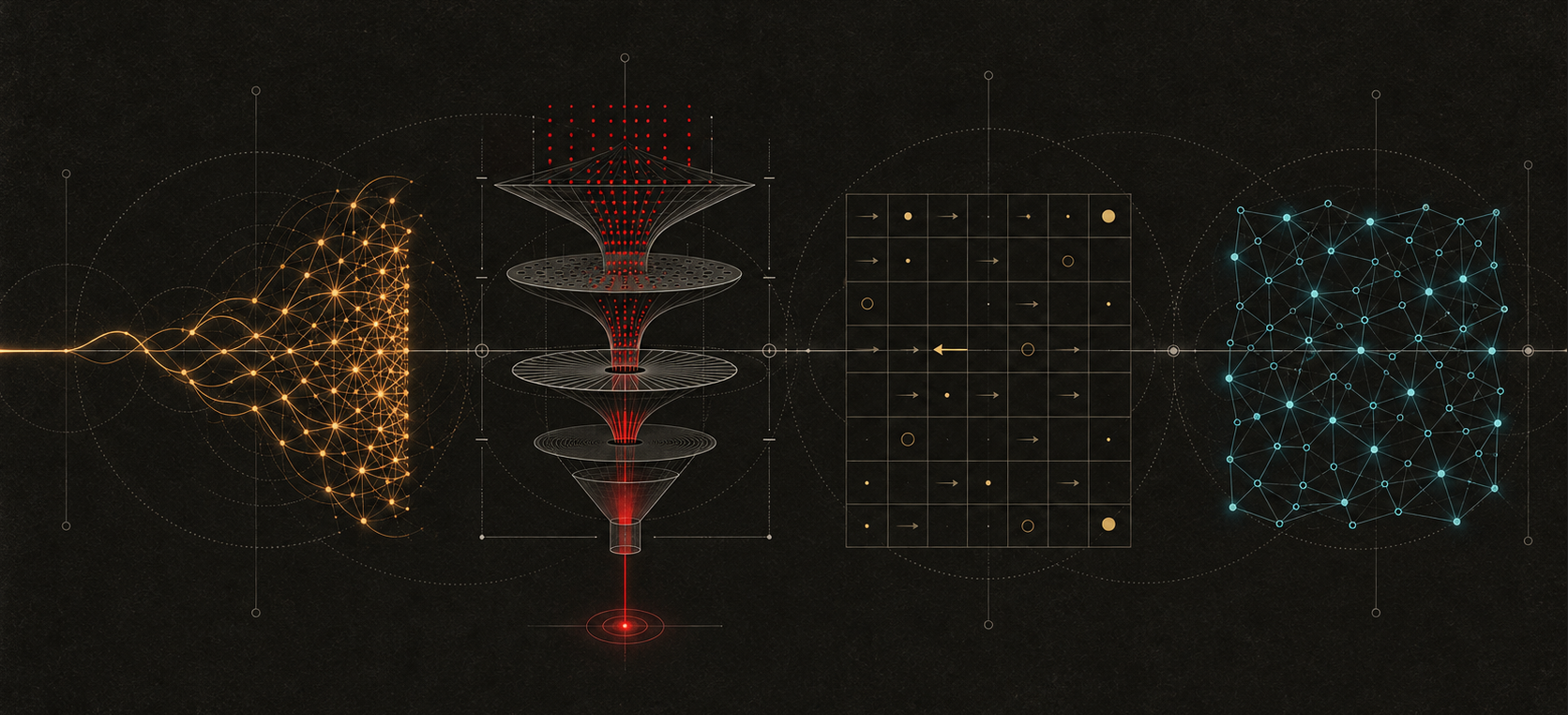
Over the past two years the work on this site has organised itself into four named functions. They are not brands, they are not alter egos, and they are not a marketing device. Each one exists because a specific analytical job needed doing and needed to be done in a voice with its own rules, so that its output could be audited separately.
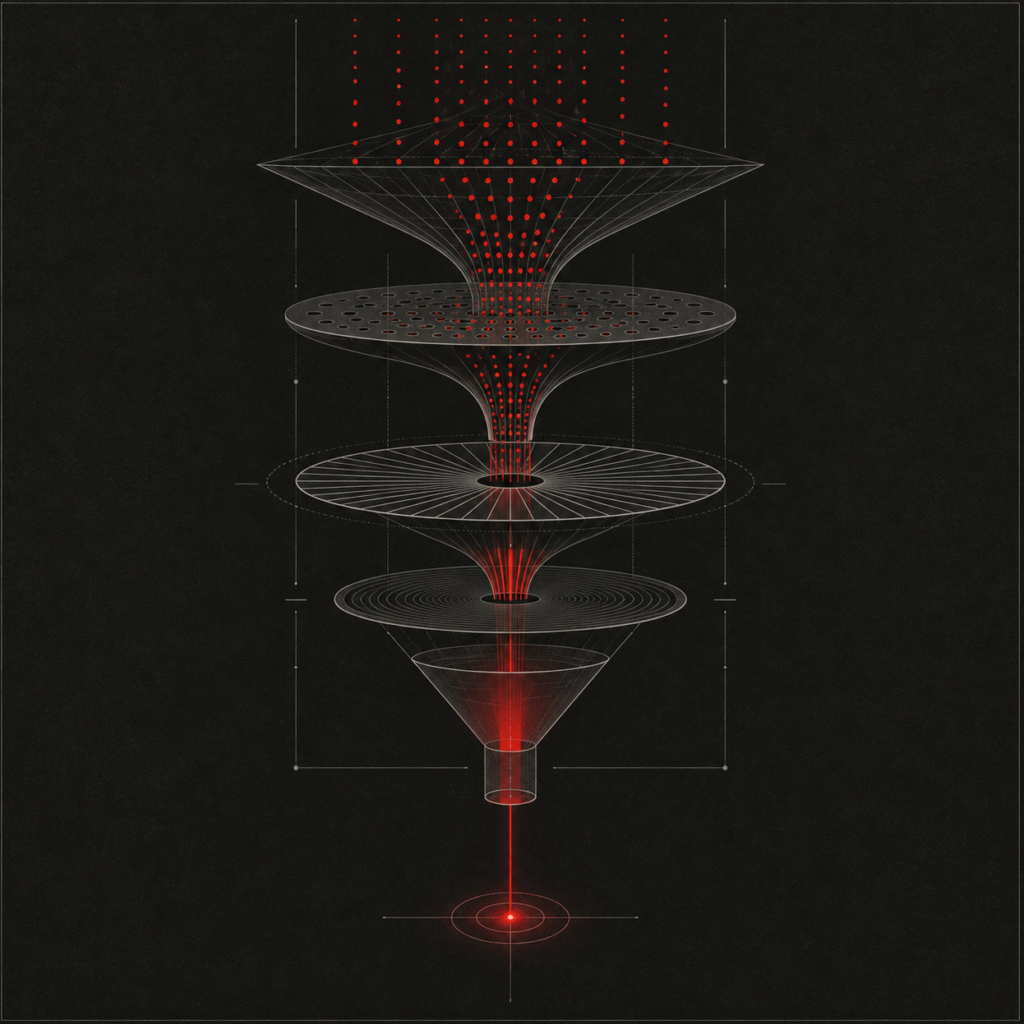
Here they are, plainly. Geometrically, we can use abstract to depict each of the personas. These are inspired from geometric yantras which are allegorical.
THEALPHASWARMER
The originating voice, publishing since 2010. It reads across innovation, macroeconomics, market structure and systems thinking and writes the long-form argument. Its discipline is that a claim must be dated, sourced, and left standing where it can later be checked — including when it is wrong.

THEOMEGASWARMER
The primary intelligence engine. It forms the thesis: the causal chain, the transmission mechanism, and the live state of confirmation or invalidation. Its discipline is that time is permission, never direction — and that a precondition met is not an event occurred.
THEGAMMASWARMER
The contrarian overlay, and deliberately the adversary of the one above it. It begins with the variables that do not align with the thesis, asks what is missing or merely lagging, and reports what could turn first. Its discipline is absolute: a leading warning is never reported as a completed event, and a missing measurement is recorded as unmeasured rather than inferred.

THEBETASWARMER
The community layer, running the BetaSwarmers Discord — a live server where the frameworks are taught, tested and argued with rather than broadcast. Its discipline is that education precedes signal, that members are onboarded before they are informed, and that nothing is sold as certainty.

Four faces. One author. None of them is Mohit Bhanabhai, in the same sense that the Cross-Pollinator is not Tom Kelley and the narrator of that 2011 story was not me at a desk in a building that does not exist.
V. The part that will interest allocators
Here is where I think this stops being a piece about identity and becomes a piece about portfolio construction.
When I built GAMMA, I did not build it to agree with OMEGA. I built it specifically to disagree — to take the same market and start from the conditions that refuse to confirm the thesis. On any given day the two functions can and do reach opposing readings, and on 24 September 2026 they did exactly that: OMEGA’s framework warned; GAMMA’s scorecard recorded four credible precursors and zero completed transmissions, and returned a verdict of leading warning, lagging veto.
That disagreement is not a malfunction. It is the entire reason both exist.
Anyone who has built a portfolio will recognise the shape of this immediately. You do not diversify by buying more of what you already own in a different wrapper — that is duplication wearing the costume of diversification. You diversify by holding exposures whose returns are imperfectly correlated, so that the drawdown of one is not the drawdown of all. The defensive sleeve is not a lack of conviction in the growth sleeve. It is the acknowledgement that conviction is not the same thing as certainty, and that the cost of being wrong is asymmetric.
Personas, used intelligently, work the same way:
- Complementary — each covers ground the others structurally cannot. The community voice cannot also be the adversarial one without losing the room.
- Counter-cyclical — GAMMA is loudest precisely when OMEGA is most confident, which is exactly when a thesis is least examined and most expensive to be wrong about.
- Separately auditable — because each has its own mandate, each can be scored on its own record. A single undifferentiated voice can only ever be judged as a whole, which in practice means it is never judged at all.
A single voice is a concentrated position. It has one correlation to reality, and when that correlation breaks there is nothing else in the book. A structured set of declared personas is a diversified book of cognition — and like any diversified book, its value shows up not in the good quarter but in the bad one.
This is why I think the reflexive suspicion of online personas gets the risk backwards. The danger is not the founder who declares four voices with four mandates and publishes the rules each one operates under. The danger is the founder with one voice, perfectly consistent, never contradicted, in which every position confirms every other position — because that is not integrity. That is an unhedged book with excellent marketing.
VI. What the tapestry can and cannot tell you
So: read the work. Read all of it. Fifteen years of it is public and dated and none of it has been quietly deleted, including the parts that aged badly and the corrections I have had to publish against my own earlier arguments.
The tapestry is real, and it will tell you a great deal — about how an argument is constructed, whether sources are checked before publication, whether an invalidation condition is stated in advance or invented afterwards, and whether the author is willing to write the sentence I was wrong about this, here is the primary source that shows it.
Those are, I would argue, the only things about a thinker that genuinely matter to anyone deciding whether to work with them.
But the tapestry will not tell you who I am, and it is not intended to. A persona is an instrument for producing insight, not a window onto the person holding it. Its readings are about the market, the system, the argument. They are not about its author’s morning, his family, his convictions, his difficulties, or his private life — and they were never offered as evidence of any of those things.
That is not evasion. It is the same contract the mask has carried since the Greeks, and the same one Kelley describes when he tells you the Anthropologist is a role you step into rather than a person you are. It is what allows the work to be criticised properly, because you can attack the framework without attacking the man, and the man can concede the framework without conceding himself.
I told you how to read this in 2011, in the title of the first thing I wrote here.
Read between the lines. There is a great deal there. It is simply not a confession — it never was.
About the author
Mohit (Max) Bhanabhai is the founder of E-Unit Australia and the author behind thealphaswarmer, which he has published since 2010.
He holds an MBA (Finance) from the Australian Institute of Business, completed in January 2026, together with a Graduate Certificate in Management and a Distinction in Corporate Finance. He is a published author with IUP Publications (ICFAI University Press), including in The Effective Executive, and has contributed to sustainable development work with the South Pacific Tourism Organisation on climate resilience in Pacific economies.
His written work spans innovation systems, the concurrent innovation paradigm, macroeconomic policy, market structure and augmented intelligence — the through-line being a conviction that human judgement and machine capability should compound on each other rather than one replacing the other.
Through E-Unit he works with enterprises, SMEs, governments, sovereign wealth funds and consulting groups on innovation capture, systems diagnosis and turning research discipline into a repeatable operating framework.
👉 eunit.au — professional consulting, engagement enquiries, research and track record.
Enquiries for pilot engagements can be made through the briefing form at eunit.au. Nothing in this article is financial advice.
Related: Destroyer or Creator · An Icebreaker — Read Between The Lines · Impersonation and Scams Nullify Value · Balancing Tension: The Dynamic Coordinator · Augmented Intelligence As The Nexus