


The trading education industry has a number it would rather you didn’t sit with. Not the loss statistics on broker homepages — those are mandated, and we’ll get to them — but a quieter one, from the industry’s own records, surfaced in a US enforcement action this decade: of the people who sign up to one of the world’s largest trading academies, *roughly 60% quit within a month, and 90% within six*.
That is not a marketing problem. That is a pedagogy problem. And I want to argue something specific about it: the industry’s core product — *one templated course, sold identically to everyone, wrapped in live scan sessions, weekly outlooks and setup feeds* — is structurally incapable of producing competent traders, no matter how good the content is. The evidence for that claim comes from two places that rarely meet: two decades of trader-outcome research, and half a century of learning science. Put them side by side and the conclusion writes itself.

The arithmetic the industry sells against
Start with what actually happens to people who trade actively.
In Brazil, researchers with regulator-supplied data followed *every person who began day trading equity futures between 2013 and 2015*. Their finding, in their own words: “it is virtually impossible for individuals to day trade for a living, **contrary to what course providers claim*. We find that 97% of all investors who persisted for more than 300 days lost money. Only 1.1% earned more than the Brazilian minimum wage.” Note who that sentence is aimed at. Academics are not usually that direct. (Chague, De-Losso & Giovannetti, *Day Trading for a Living?*, SSRN working paper 3423101 — a working paper)
Taiwan gives us the peer-reviewed version, because for years its exchange data allowed researchers to see everyone. Barber, Lee, Liu and Odean found that in a typical six-month period, *more than eight out of ten day traders lose money*; in the published *Journal of Financial Markets* version covering 1992–2006, *“less than 1% of the day trader population is able to predictably and reliably earn positive abnormal returns net of fees.“* The aggregate damage was macroeconomic: individual investors’ trading losses ran to **2.2% of Taiwan’s GDP** (*Review of Financial Studies*, 2009).
Then the paper that matters most for education, with the most honest title in the literature: *Learning, Fast or Slow* (Review of Asset Pricing Studies, 2020). Its findings: “74% of day trading volume is generated by traders with a history of losses” and “97% of day traders are likely to lose money in future day trading.” Read that first clause again. Three-quarters of the activity comes from people the data already knows are losing.** People are not learning from experience — the paper’s conclusion is that the persistence pattern fits overconfidence and biased learning, not rational updating. Experience, unstructured, does not teach this game.
The regulators’ numbers rhyme. The FCA sampled real client accounts across eight CFD firms in 2016: *82% lost money, average loss £2,200*. ESMA’s 2018 pan-European analysis: *74–89% of retail accounts lose*, average losses from €1,600 to €29,000 — the reason every European broker’s homepage now carries that percentage banner. France’s AMF: 89%. ASIC watched Australian retail CFD clients lose *more than $774 million net in five weeks** of the March 2020 volatility.
We must agree however the assumption , as everything is based on assumptions! Those regulator figures measure *leveraged-product outcomes, not course outcomes*. Nobody has published an independent academic study of trading-course graduates — the closest things we have are enforcement records. That is itself an indictment: an industry selling education, at four and five figures a seat, with *no published outcome data anywhere*.
Imagine a surgery school that had never once reported what happened to its graduates’ patients.
What the industry actually sells
Now look at the product against that backdrop.
A cohort signs up — and in any Australian, British or American intake, that cohort is genuinely various: different first languages, different capital bases (someone’s $2,000 alongside someone’s $200,000), different working hours and timezones relative to the session being taught, different family obligations, different relationships to risk, debt and money itself — differences that are partly cultural, partly circumstantial, entirely real.
Hofstede’s classic work on how classroom behaviour differs across cultures is contested in its details (McSweeney’s critique is worth reading before you lean on it), but the underlying observation survives every critique: who speaks, who asks, who admits confusion, and who quietly disappears varies enormously across the people in that room. And there is causal evidence that relevance to the learner changes outcomes — Dee and Penner’s study of a culturally relevant curriculum found large effects on attendance and achievement for the students it was designed around.
To this variety, the industry sells: one recorded curriculum. One live scan room. One weekly outlook. One setup feed. The same entry model, the same session times, the same voice, for everyone.
Learning science has been telling us for forty years what that produces. Benjamin Bloom’s famous “2 Sigma” paper (1984) found students taught one-to-one performed around two standard deviations above conventional group instruction — with the honest modern caveat, which I’ll carry rather than hide, that the two-sigma magnitude has never replicated at scale; contemporary tutoring studies find real but smaller effects. The mastery-learning meta-analyses (Kulik et al., 1990) found consistent, meaningful gains from one structural change: students advance when they demonstrate mastery, not when the calendar says the cohort moves on. VanLehn’s 2011 synthesis put human tutoring at an effect size of **d = 0.79** and intelligent tutoring systems at **d = 0.76** — individualised systems nearly matching human tutors, both far ahead of the lecture.
And the research the industry loves to gesture at — Ericsson’s deliberate practice — says the opposite of what a scan room does. Ericsson’s actual protocol requires the learner to be “given explicit instructions about the best method,” supervised individually, with **immediate informative feedback on their own performance**. A live scan session is the anti-model: you watch someone else perform, on their setups, at their pace, with no feedback loop on your decisions at all. (Even the strongest caveat to Ericsson — Macnamara’s 2014 meta-analysis showing practice explains far less of expert variance than claimed — cuts against the industry, not for it: if practice quantity explains little, then practice *design* is everything.)
Two guardrails, so this argument doesn’t get lumped in with pop-psychology: this is not the “learning styles” claim — matching teaching to visual/auditory “styles” is a debunked idea (Pashler et al., 2008), and nothing here depends on it. And financial education is not useless: the famous 2014 meta-analysis showing effects decaying to nothing was substantially corrected by Kaiser, Lusardi, Menkhoff and Urban (2022), who found real, durable effects — **when the intervention is designed rather than generic**. Which is precisely the point!
Interventions work. We have the receipts.
Here is the part of the story almost nobody in trading education tells, because it embarrasses the content-is-king model.
In 2021, ASIC stopped educating and started intervening: leverage caps, forced margin close-outs, negative balance protection. No new courses. No better webinars. Structural intervention. The result, from ASIC’s own review: **a 91% reduction in aggregate net losses by retail client accounts** in the first six months. Ninety-one percent. The single most effective “trading education” event in Australian history was a rule change.
Meanwhile the education industry’s own report card is being written by regulators of a different kind. The FTC sued Online Trading Academy in 2020 over “false or unfounded earnings claims” attached to training programs costing thousands. In May 2025 the FTC and the State of Nevada moved against IM Mastery Academy/IYOVIA — the action that put the 60%-gone-in-a-month figure on the public record. In January 2025 the UK’s Advertising Standards Authority upheld a ruling against a trading-education app’s ad promising a path from “$20” to becoming “the first millionaire in your family.” The pattern isn’t a few bad apples. It is what a one-size, promise-led, outcome-blind model produces under commercial pressure.
The interventionist alternative
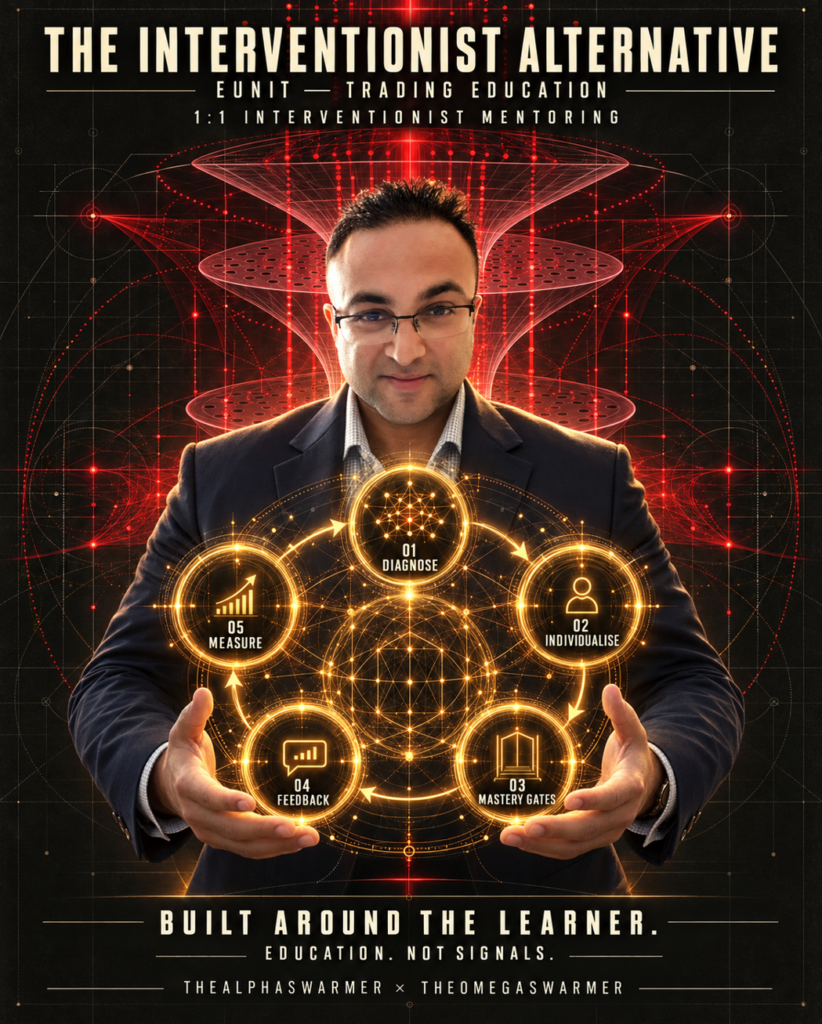
So what would trading education look like if it took both bodies of evidence seriously? Not more content. Intervention — in the clinical sense: diagnose, individualise, gate, feed back, measure.
Diagnose before you teach: Capital base, available hours and timezone, first language, obligations, risk temperament, prior record if any. A person with $3,000 and a night job cannot be taught the same trade plan as a person with $150,000 and their mornings free — not “shouldn’t.” Cannot. The plan that fits one is malpractice for the other.
Mastery gates, not calendar cohorts: Nobody advances to live risk because week six arrived. They advance when they’ve demonstrated the prior stage — journalled, reviewed, evidenced. Bloom and Kulik have been right about this since before most course founders were born.
Feedback on the student’s own decisions: Ericsson’s actual finding. The unit of teaching is the student’s last ten trades — their entries, their invalidations honoured or violated, their sizing — reviewed individually, with the objections stated. Watching an instructor scan charts is entertainment with educational lighting.
Objections travel with every idea: Every setup taught with its failure condition attached, every outlook published with what would prove it wrong. If the invalidation isn’t stated before the trade, it isn’t education; it’s a signal with homework.
Published outcomes: The brokers were forced to put their loss percentages on the homepage; it changed the industry. Educators should be held — or hold themselves — to the same banner: *of our last intake, this percentage completed; this percentage still trades at twelve months; here is the register, dated.* I publish a register of my own calls, including the failures scored in public, for exactly this reason. It is the only form of marketing that survives contact with the evidence.
None of this scales like a webinar funnel. That is the point. The current model scales because it ignores the learner; the evidence says whatever ignores the learner doesn’t work; therefore the industry’s scalability is precisely the measure of its failure.
What would prove this thesis wrong: an independent, audited dataset showing a single-curriculum, scan-room-supported program producing durable positive outcomes across a demonstrably varied intake. I’ll publish it he re the day it exists. The industry has had thirty years to produce it.
—
Sources
**Trader outcomes:** Chague, De-Losso & Giovannetti, *Day Trading for a Living?* (SSRN 3423101, working paper, 2020) · Barber, Lee, Liu & Odean, *Do Individual Day Traders Make Money?* (2004) and *The Cross-Section of Speculator Skill*, J. Financial Markets 18 (2014) · Barber, Lee, Liu, Odean & Zhang, *Learning, Fast or Slow*, Rev. Asset Pricing Studies 10(1) (2020) · Barber et al., *Just How Much Do Individual Investors Lose by Trading?*, Rev. Financial Studies 22(2) (2009).
**Regulators:** ESMA press release ESMA71-98-128 (27 Mar 2018) · FCA CP16/40 (Dec 2016) and FCA press release, permanent CFD restrictions (1 Jul 2019) · ASIC 20-254MR (22 Oct 2020) and 22-082MR (2022).
**Enforcement:** FTC v. Online Trading Academy (Matter 182-3175, filed 12 Feb 2020) · FTC & State of Nevada v. IYOVIA/IM Mastery Academy (announced 1 May 2025) · ASA ruling A24-1265945, Zimran Ltd t/a Prosperi Academy (15 Jan 2025).
**Learning science:** Bloom, *The 2 Sigma Problem*, Educational Researcher 13(6) (1984); von Hippel, *Two-Sigma Tutoring*, Education Next (2024) on non-replication · Kulik, Kulik & Bangert-Drowns, Rev. Educational Research 60(2) (1990) · VanLehn, Educational Psychologist 46(4) (2011) · Ericsson, Krampe & Tesch-Römer, Psychological Review 100(3) (1993); Macnamara, Hambrick & Oswald, Psychological Science 25(8) (2014) · Pashler, McDaniel, Rohrer & Bjork, PSPI 9(3) (2008) · Hofstede, Int. J. Intercultural Relations 10(3) (1986); McSweeney, Human Relations 55(1) (2002) · Fernandes, Lynch & Netemeyer, Management Science 60(8) (2014); Kaiser, Lusardi, Menkhoff & Urban, J. Financial Economics 145(2) (2022) · Dee & Penner, American Educational Research Journal 54(1) (2017).
*Evidence notes, kept deliberately: the Brazil study is a working paper; the Bloom two-sigma magnitude has not replicated at scale; regulator loss statistics measure leveraged products, not courses — the absence of published course-outcome data is part of the argument; ESMA’s 74–89% range is a 2018 figure, not a current one; and no study directly tests culturally varied cohorts in a single-model trading course — that conclusion is built here by inference from the cited pieces, and is stated as such. Information and education only; nothing here is financial advice.*
Update, 30 September 2026: how this desk applies the interventionist model described above — diagnosis first, mastery gates, recorded 1-on-1 review of the student’s own trades, engine-checked objections and a published outcome register — is set out at eunit.au/trading-education, including the enquiry route for trading-education companies that want their own product audited against it.