
Part of the wellbeing series. Written 20 September 2026.
Four years ago, in Gamification Symmetry With Maslow’s Hierarchy of Needs, I opened with a claim I want to now take under the hood: that “neuroscience identified key chemical transmissions that entertain the human psyche amidst the concurrent ebb and flow of information in a distracted age.” That piece argued engagement can be designed. This one asks a harder question underneath it: when we chase a thrill — the presentation, the first run down a slope, the deadline we half-invited — what is actually happening in the brain, and does chasing it make us well?
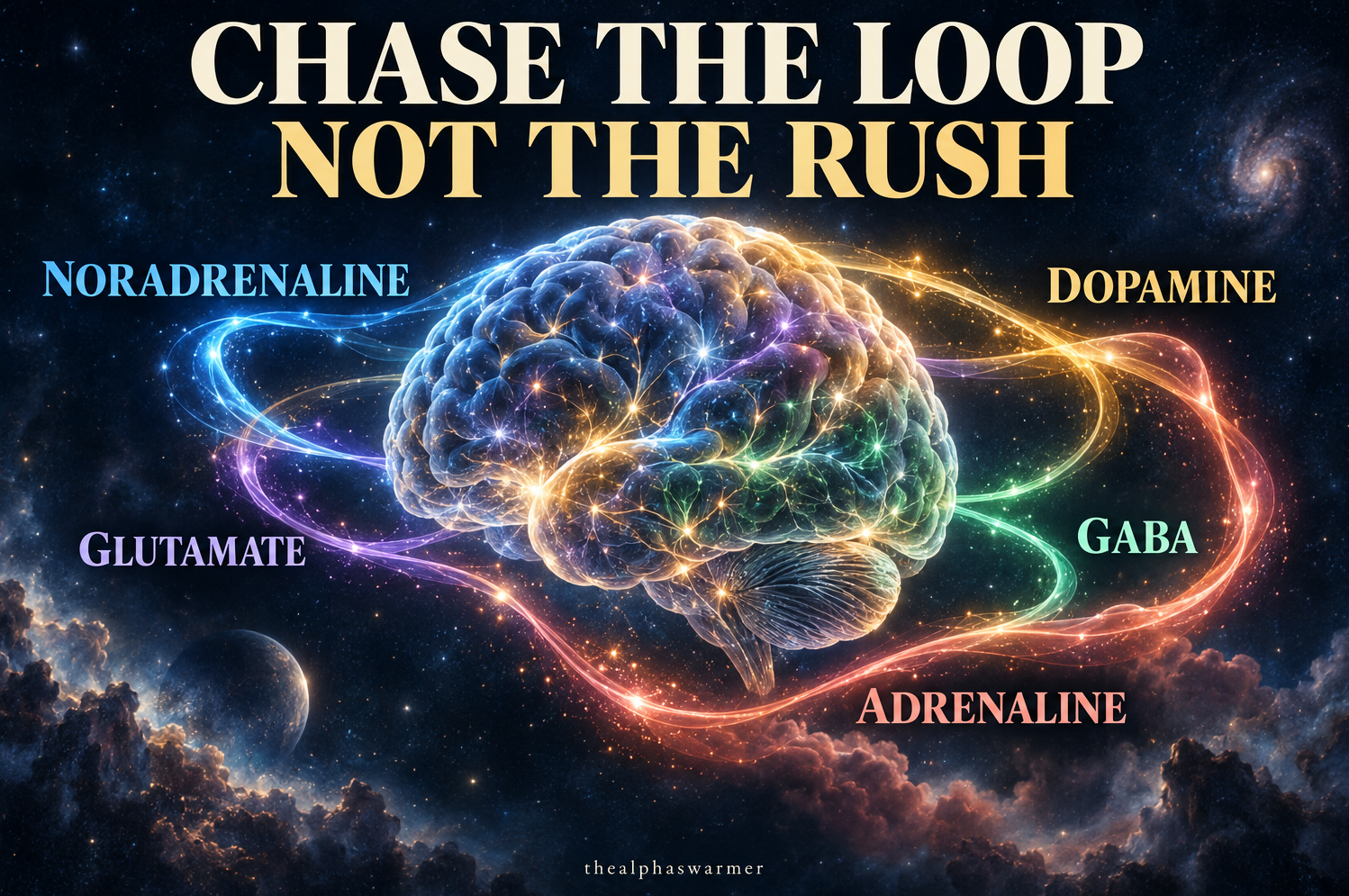
The honest answer reframes the popular one. It is not the rush that builds wellbeing. It is the loop the rush is only the first step of.
The rush is mostly hormonal — and it is not the reward
Start with the chemical everyone names. Adrenaline (epinephrine) can act as a neurotransmitter in a few neurons, but the familiar “adrenaline rush” is principally a circulating hormonal response — the body mobilising energy to meet a challenge. It is real, and it is useful. But adrenaline is not the brain’s reward chemical, and it does not, on its own, explain why we come back for more.
The messenger that does the alertness work inside the brain is its close cousin, noradrenaline (norepinephrine) — the system behind readiness, attention and the felt sense of being switched on. Feeling intensely activated, though, is not the same as attending accurately or deciding well; arousal helps focus only up to a point, and past it, degrades it.
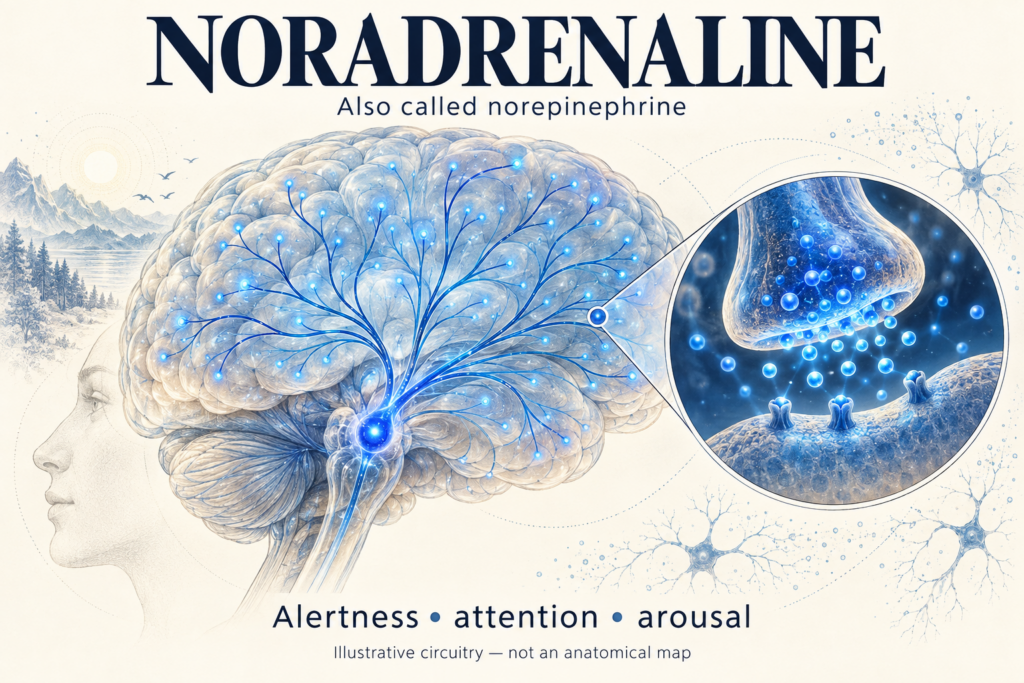
“The brain’s alertness booster.” Caption: Noradrenaline helps regulate alertness and attention. Useful focus depends on context and appropriate arousal.
Why we go back: dopamine, not adrenaline
The pull to repeat an exciting experience is a dopamine story, not an adrenaline one. Dopamine-linked circuitry assigns value to experience and drives the motivation to seek it again. This is not folklore: in a placebo-controlled, double-blind human study, Norbury and colleagues showed that manipulating dopamine D2 receptors altered the value people assigned to intense sensory stimulation — but only in those already inclined to approach it. Dopamine helps explain why some of us find the edge rewarding.
And here is the part a careful writer must not skip. The same body of research treats high sensation-seeking as a genuine vulnerability factor — associated with real risks, not just zest for life. So “more thrill” cannot be the prescription. The dopamine that makes challenge feel worth repeating is the same dopamine that can pull a person past the manageable and into the harmful. The chemistry is neutral; the relationship is everything.
Learning and recovery: the half of the loop nobody posts about
An experience only strengthens you if two quieter systems do their work afterwards. Glutamate, the brain’s principal excitatory messenger, underwrites the synaptic plasticity of learning — turning an intense experience into a skill you keep. And GABA, the major inhibitory messenger, does the unglamorous, essential job of regulation and recovery — settling the system back down so the next engagement starts from balance rather than depletion.
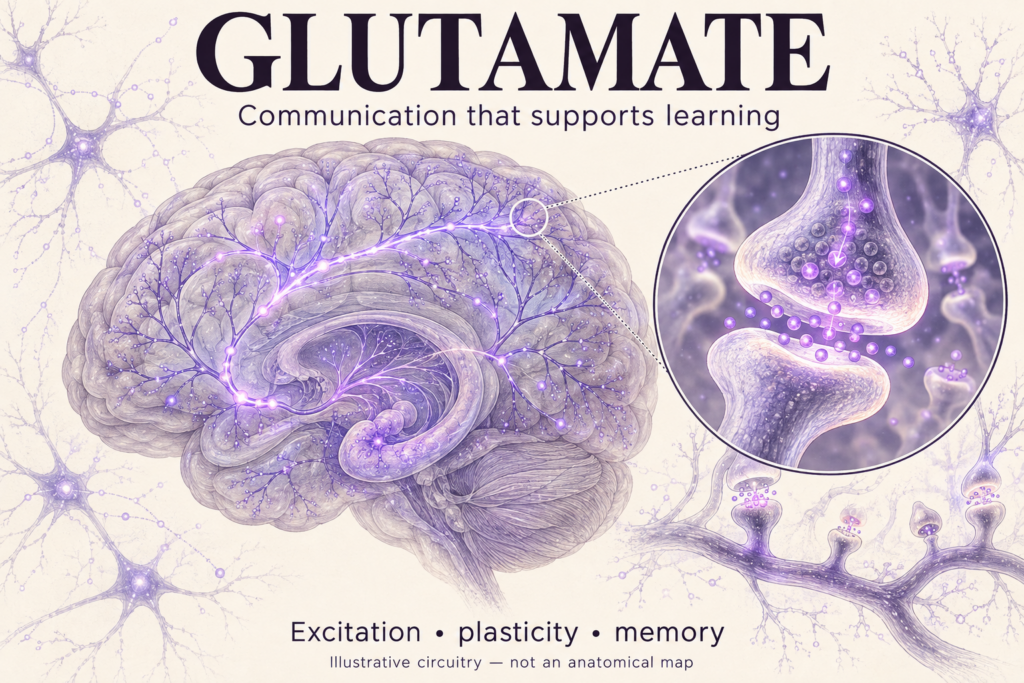
“The brain’s connection builder.” Caption: Glutamate supports excitatory communication and the synaptic changes involved in learning and memory.
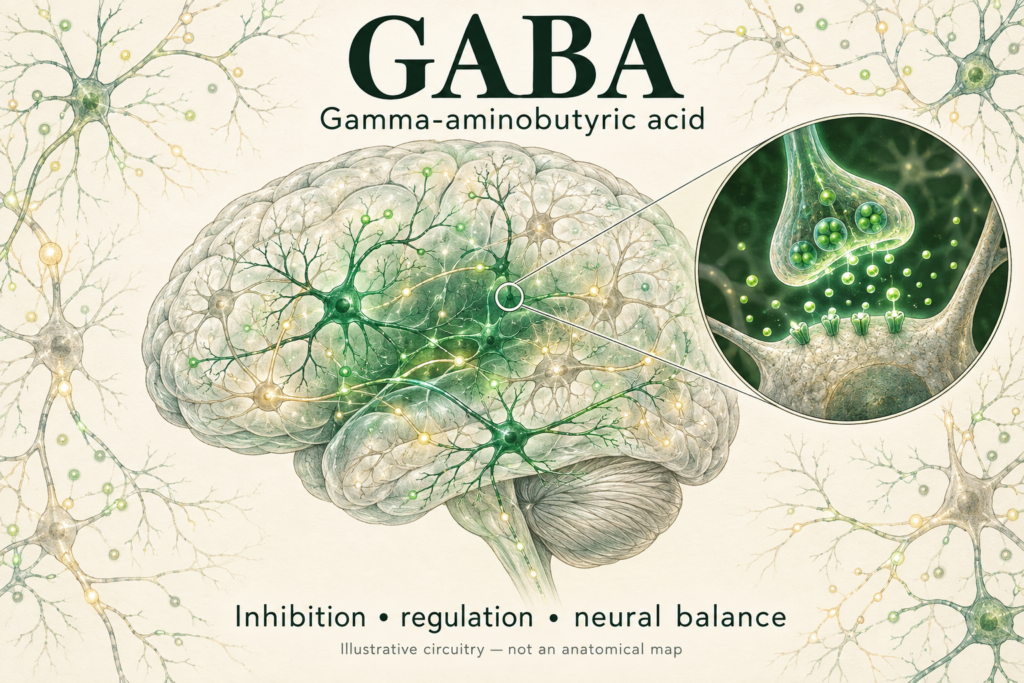
“The brain’s calm crew.” Caption: GABA-mediated inhibition helps regulate neural excitability; calm and sleep involve broader interacting systems.
These systems do not take turns — glutamate during the challenge, GABA during the cooldown. They interact continuously. Which is precisely why maximising any one of them is the wrong goal: a biochemical increase is not a benefit, and no honest picture reads “one chemical, one feeling.”
The defensible thesis — chase the loop, not the rush
So: do adrenaline-type activities strengthen wellbeing? They can — but not because they spike a chemical. They strengthen wellbeing when they run the whole loop: mobilise energy (adrenaline), direct attention (noradrenaline), find the experience rewarding enough to return to (dopamine), learn something that stays (glutamate), and recover so the next attempt begins from balance (GABA). Purposeful challenge, in manageable doses, followed by recovery. Sensation without learning is just arousal; arousal without recovery is just wear.
This is exactly where the gamification-and-Maslow model earns its keep. Good game design is not a dopamine slot machine; it is a discipline for delivering challenge calibrated to skill, with feedback, mastery and progression — the healthy-challenge loop, engineered. It climbs Maslow’s needs precisely because it lets a person meet a stretch, learn from it, and level up rather than burn out. And as I argued in Performance, Not Presence, the payoff of engaged attention is not the intensity of the moment but what the mind builds from it.
Where mindfulness fits
Mindfulness belongs here not as a chemical lever but as the skill that runs the loop deliberately: noticing your level of arousal — the rush, the pull to push further, the moment focus tips into frazzle — and choosing the response. It makes room for both engagement and calm. I will not claim it reliably raises a particular neurotransmitter; the honest claim is smaller and more useful: awareness lets you decide when to lean into the challenge and when to let the system recover.
Seek the edge, then. Invite the manageable challenge, the stretch that scares you a little. But measure the win by what you learned and how well you recovered — not by how high the needle went. Constant adrenaline is not a measure of wellbeing. A good relationship with challenge is.
Related on this site: Gamification Symmetry With Maslow’s Hierarchy of Needs · Performance, Not Presence · Why Hypnosis Often Works After Everything Else.
References: Norbury, A., Kurth-Nelson, Z., Winston, J. S., Roiser, J. P., & Husain, M. (2015). Dopamine Regulates Approach-Avoidance in Human Sensation-Seeking. International Journal of Neuropsychopharmacology, 18(10), pyv041 — https://doi.org/10.1093/ijnp/pyv041. ·
Norbury, A., & Husain, M. (2015). Sensation-seeking: Dopaminergic modulation and risk for psychopathology. Behavioural Brain Research. · Sheffler, Z. M., Reddy, V., & Pillarisetty, L. S. Physiology, Neurotransmitters. StatPearls — https://www.ncbi.nlm.nih.gov/books/NBK539894/. · Endocrine Society, Adrenal Hormones — https://www.endocrine.org/patient-engagement/endocrine-library/hormones-and-endocrine-function/adrenal-hormones.
Educational content, not medical advice. The character graphics are illustrative teaching aids, not scientific evidence. Opinion and synthesis of #thealphaswarmer.