

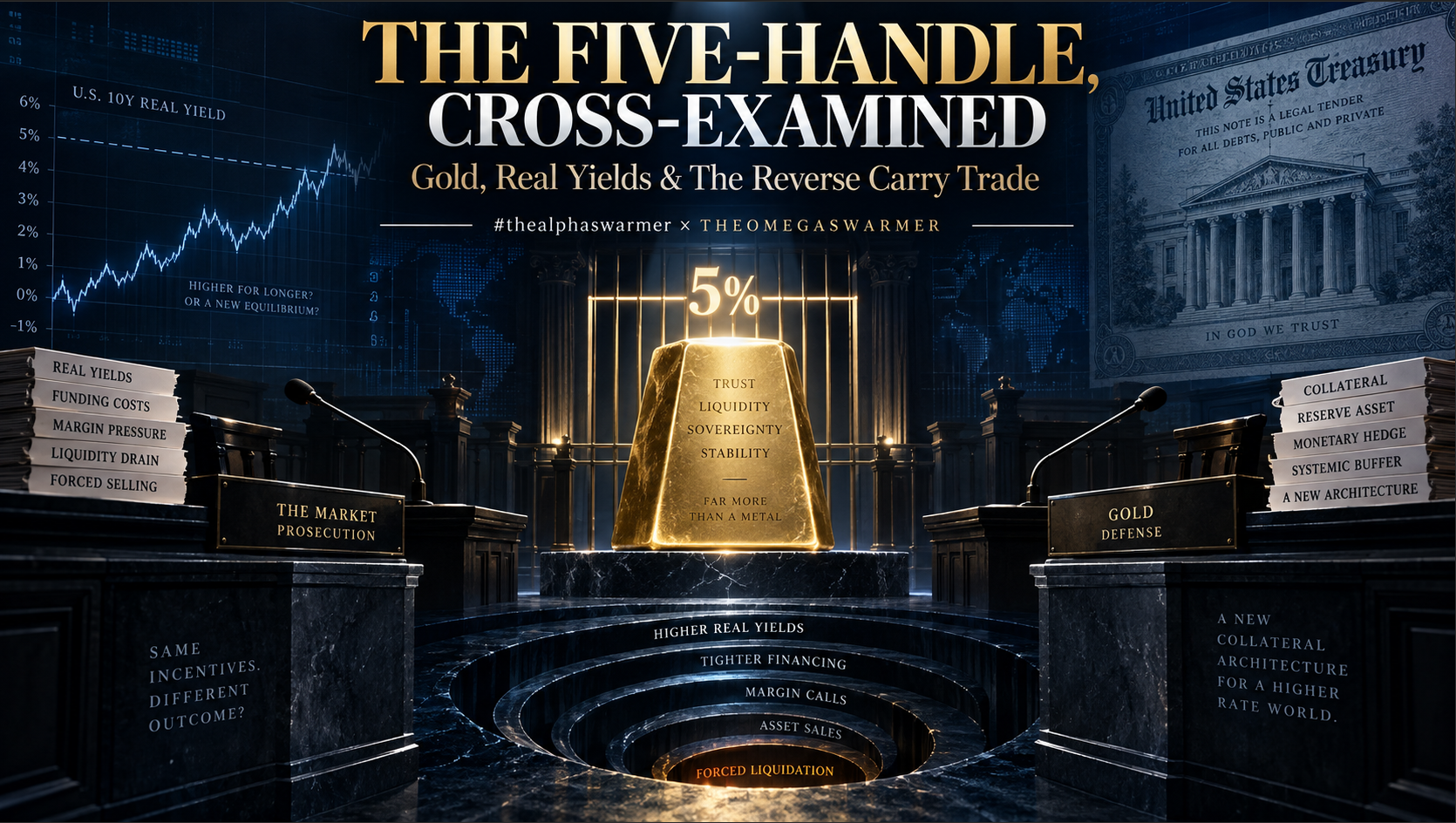
Written 23 September 2026 (AEST). A cross-examination of the sell-side consensus on gold, the five-handle, and the reverse carry trade — and a continuation of a thesis I have been putting on the record since April 2022. Every market figure below was pulled from primary sources on the day of writing; the workings are stated so they can be checked.
The witness
A broker’s morning note landed this week carrying three propositions that, taken together, describe how most of the market is currently positioned. They are worth stating plainly, because they are internally coherent and each one is defensible on its face:
- The US 10-year yield has crossed above 5% for the first time in over a year, and the two prior instances since 1962 were followed by equity losses of −19.8% and −6.4%.
- Gold has become the world’s largest reserve asset at roughly $5 trillion, overtaking US Treasuries, and is “now the main collateral for central banks” — with the historic relationship between gold and real yields broken ever since Washington seized Russia’s reserves.
- Complacency is extreme — Nasdaq one-month put-call skew at zero, among the lowest readings in two decades — and the appropriate response is to reduce risk and hedge.
The implied trade is the one the market always runs at this point in the cycle: the assets that delivered during the uncertainty get rotated out of, and hedged, precisely when the thing they were protecting against begins to arrive. Gold did its job for two years; now the risk-free rate has a five-handle, so sell some gold, buy some Treasuries, and put a collar on the equity book.
I want to test that. Not rhetorically — against the primary data. What follows is structured as a cross-examination: each proposition is put, tested, and then either survives, is modified, or fails. I have tried to run it the way a hostile counsel would, including against my own position, because a thesis that has not been cross-examined is just a preference with footnotes.

Proposition 1 — “The five-handle is a warning”
Put to the witness: the 10-year has crossed 5%, and the two prior crossings were followed by −19.8% and −6.4%.
I reconstructed this from the source series. Using the Federal Reserve‘s constant-maturity 10-year (DGS10, which begins in 1962) and the S&P 500, and defining the event exactly as the note does — a cross up through 5.00% with the preceding twelve months entirely below 5% — there are precisely three occurrences in sixty-four years:
- 28 February 1966 (10-year 5.02%)
- 13 April 2006 (10-year 5.05%)
- 15 September 2026 (10-year 5.00%)
The first correction is a small one but it matters for anyone checking the work: the note dates the earlier episode to February 1965. On the Fed’s own series the crossing is February 1966.
The second correction is not small at all. Here is what actually happened after each crossing:
| Crossing | +3 months | +6 months | +12 months | Max drawdown within 12m |
|---|---|---|---|---|
| 28 Feb 1966 | −5.6% | −18.3% | −4.9% | −19.8% (trough 7 Oct 1966) |
| 13 Apr 2006 | −3.6% | +5.7% | +12.7% | −5.1% (trough 13 Jun 2006) |
The −19.8% figure is real. It is exactly the twelve-month maximum drawdown from the 1966 crossing. But it is a drawdown, not a return. The twelve-month forward return from that crossing was −4.9%. And the 2006 episode — the one the note scores at −6.4%, which is close enough to the −5.1% closing drawdown that I accept it as a fair reading — ended the year up 12.7%.
Finding: the proposition survives, but not in the form it was offered. Two crossings, two meaningful drawdowns, and two completely different year-ahead outcomes — one modestly negative, one strongly positive. A sample of two supports no statistical claim whatsoever, and I will not pretend otherwise. What it weakly suggests is a volatility warning, not a direction warning.
That distinction determines the entire trade. If the five-handle predicts a drawdown you will recover from, the correct response is not to de-risk. It is to stay invested and buy convexity — which is the opposite of the rotation reflex, and which costs money you have to fund from somewhere. Hold that thought; the funding question is where this argument ends up.
Proposition 2 — “Gold has overtaken Treasuries as the world’s top reserve asset”
Put to the witness: gold reserves have hit $5 trillion and overtaken US Treasuries; gold is now the main collateral for central banks.
The headline is sourced, ultimately, to the European Central Bank’s The international role of the euro, June 2026. So I went and read the ECB.
The ECB does say it. Gold reached 27% of total official foreign reserves at end-2025, against US Treasuries at 22% and the euro at 15%. On that measure the headline is accurate.
But the ECB does not stop at that sentence, and the next one is the one nobody quoted. Correcting for valuation effects — holding gold at its end-2023 price — the ECB reports that gold’s share is 16%, the euro’s is 16%, and US Treasuries remain markedly higher at 26%. The report is explicit about why: “this development largely reflects valuation effects… the gold price surged by around 60% and 30% in 2025 and 2024 respectively, which mechanically increases the share of gold in total official foreign reserves.”
Gold did not overtake Treasuries because central banks bought gold and sold Treasuries. Gold overtook Treasuries because gold went up. It is a mark-to-market artefact being reported as a portfolio decision.
And the flow data cuts the other way again. Central banks bought roughly 850 tonnes in 2025, down from more than 1,000 tonnes annually across 2022–2024. The official-sector bid — the very bid that is supposed to justify the re-rating — is decelerating while the price accelerates.
Finding: the proposition fails in the form offered. Gold’s reserve status has genuinely risen, and 36,000 tonnes is not nothing. But “gold is now the world’s top reserve asset” is a statement about price, dressed as a statement about allocation.
This is adverse to my own thesis and I am putting it up front rather than burying it, because it connects to the note’s own most honest observation: gold’s price and gold ETF holdings have diverged since mid-August. Put the three quantity measures side by side — ETF ounces flat, central bank tonnes slowing, valuation-adjusted reserve share at 16% — and the same pattern appears on every one of them. Price is outrunning quantity across the board. Anyone long gold here needs an answer to that, and “it’s collateral now” is not an answer. It is an alibi.
Proposition 3 — “The gold / real-yield relationship has broken”
Put to the witness: the historic relationship between gold and real yields broke when the US seized Russia’s assets.
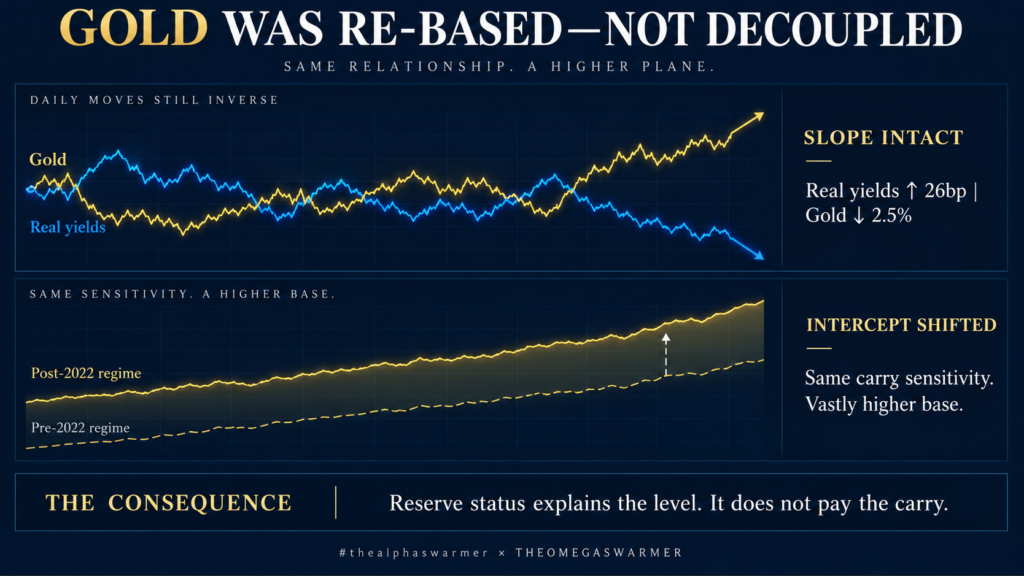
This is testable directly, so I tested it. I took the Fed’s 10-year TIPS yield (DFII10) and daily gold back to 2012, and computed the correlation of daily changes — the honest way to measure whether a relationship is functioning, rather than comparing levels, which any two trending series will appear to share.
| Window | Observations | corr(Δgold, Δreal yield) |
|---|---|---|
| 2012–2015 | 997 | −0.219 |
| 2016–2019 | 998 | −0.404 |
| 2020 – pre-invasion | 537 | −0.318 |
| Post-seizure 2022–23 | 462 | −0.486 |
| 2024 | 250 | −0.324 |
| 2025 | 249 | −0.035 |
| 2026 YTD | 179 | −0.178 |
The period immediately following the seizure of Russian reserves produced the strongest negative correlation in the entire fourteen-year sample. The relationship did not break when the assets were seized. It tightened.
And it is working right now. Over the three weeks into the five-handle crossing:
- 10-year nominal: 4.77% → 5.01% (+24bp)
- 10-year real: 2.42% → 2.68% (+26bp)
- 10-year breakeven inflation: 2.35% → 2.33% (−2bp)
- Gold: $4,539.9 → $4,424.9 (−2.5%)
Real yields up, gold down. Textbook. The relationship the note declares broken performed exactly as specified during the very event the note is describing.
Two things follow, and the second is the more important.
First — and this is the single most consequential number in this article — the entire move was real. Nominal yields rose 24bp; real yields rose 26bp; breakevens fell two basis points. There is no inflation-expectations content in this repricing at all. The market is not demanding compensation for inflation. It is demanding a higher real return to fund the United States government. That is a term-premium and solvency-arithmetic event, not an inflation event — which is precisely the argument I made in The Prophecy, Continued. The long end has stopped taking its instructions from the policy rate.
Second — the witness is half right, but about the wrong parameter. Fit a simple regression of log gold on the 10-year real yield over 2012–2021, and it implies gold should trade around $750 at a 2.68% real yield. Gold is $4,425. That is roughly 5.9 times the model.
Let me immediately discipline that number before anyone quotes it: a log-linear model extrapolated far outside its fitted range is not a valid point forecast, and I am not claiming gold “should” be $750. The magnitude is the message, not the level. No plausible re-specification of the old relationship gets you anywhere near $4,400.
Finding: the proposition is modified, not sustained. The slope survived — gold still moves inversely to real yields, day by day, including this month. The intercept did not. Gold trades around real yields exactly as it always has, but from a vastly higher base. Something added a large, persistent level term somewhere between 2022 and now.
So the correct statement is not “gold has decoupled from real yields.” It is: gold has been re-based while remaining fully carry-sensitive.
And that is a far more uncomfortable conclusion for gold bulls than the one the note offers, because it means the reserve-asset story — whatever its merits — does not exempt gold from the cost of carry. If the slope is intact, a five-handle risk-free rate still hurts, every day, regardless of how many central banks are buying. The collateral narrative explains the level. It does not pay the rent.
The real question
Strip the three propositions back and the market’s actual problem is singular and unglamorous:
Gold has performed the function it was bought for. The risk-free rate is now 5.01% nominal and 2.68% real. Gold yields nothing. Therefore sell gold, buy Treasuries, and hedge the equity book — and do it now, before the reverse carry trade forces everybody through the same door at once.
That is the rotation reflex, and I want to be fair to it: it is not stupid. It is the correct answer to the question it is asking. At 2.68% real, holding a zero-coupon lump of metal costs you 2.68% a year in foregone real return, compounding, indefinitely. Over a decade that is roughly a third of your position surrendered to opportunity cost. No narrative about reserve status survives that arithmetic if you have to fund it out of return.
I made this point against gold myself, publicly, on 23 March 2025: “This is exactly when investors and funds hedge downside by selling and offloading the bullion.” That is the mechanism. When the funding cost rises, the non-yielding asset is the first thing sold — not because anyone stopped believing in it, but because it is the cheapest thing in the book to liquidate and the only one that costs you carry to keep.
And on the reverse carry specifically, on 24 July 2026: “I think the risk of a reverse yen carry trade is increasing. Oil’s surge raises imported inflation for Japan, JGB yields continue climbing, and the yen remains historically weak.” The reason that matters here is that a reverse carry unwind does not respect your reasons for owning something. It is a margin event. It sells what can be sold.
So: the rotation reflex is correct given the constraint. Which means the only way to beat it is to attack the constraint itself.
The constraint is that gold yields nothing and cannot move.
What tokenisation actually fixes — and one correction I owe
I have been arguing this since April 2022, when I described the tokenisation of gold as “a paradigm shift and adoption frontier.” In August 2022 I put it more precisely: “tokenisation of the asset book backing the collateral would be a prudent path forward.” In April 2025: “gold will be more useful when tokenised by US treasury and other central banks.”
Now the correction, before anyone else makes it for me.
The strong form of this argument — the one I have heard repeated back to me, and have at times been loose enough to imply — is that with physical backing, a decline in the spot price does not matter.
That is wrong, and it needs to be said plainly. Spot matters enormously to a collateral holder, because haircuts and margin calls are struck on mark-to-market value, not on tonnage. A tokenised ounce that falls 20% loses 20% of its borrowing capacity on the day it falls, backing or no backing. Anyone selling you “physically backed, so price-insensitive” is selling you a category error.
The defensible claim is narrower and, I think, more powerful:
Physical backing does not make a spot decline painless. It makes a spot decline a mark-to-market event rather than a permanent impairment of the claim — because the claim is denominated in metal, not in dollars, and is redeemable in metal. Provided you are never forced to sell.
That proviso is the entire argument. And it is exactly what the rotation reflex is designed to violate: at a 5% funding cost, a non-yielding position with no income eventually does force a sale, which is why everyone sells it first.
So the question becomes precise and answerable: what would make a gold holder not forced to sell at a five-handle?
Income would. Income in ounces would do it completely.
The yield leg — the number that reframes the trade
Gold leasing is not a crypto invention; it is an old wholesale market in which a holder lends allocated metal to an industrial user or refiner and is paid in metal. What has changed is that it is now accessible outside the bullion-bank system, with custody verification and defined redemption.
Current gold lease yields run roughly 2% to 5% annually, with a reported weighted average of 3.93% on active leases in 2026 — paid in ounces, not dollars.
Set that against the Treasury:
| Nominal | Real | Denominated in | |
|---|---|---|---|
| US 10-year Treasury | 5.01% | 2.68% | USD |
| Gold lease (weighted avg) | — | 3.93% | ounces |
A yield paid in ounces on a principal denominated in ounces is a real yield, in metal. It compounds the quantity of metal you own and is structurally indifferent to the dollar price. So the honest like-for-like comparison at this moment is 3.93% in metal against 2.68% real in dollars.
That is not a rounding error. It inverts the central objection to gold at a five-handle. “Gold yields nothing” has been the strongest argument against the metal for fifty years, and it is now, for a specified and accessible portion of holdings, simply untrue.
I will not let that stand unqualified, because the gap is not free money — it is payment for risks a Treasury does not carry: the credit risk of the lessee, custody and reconciliation risk, and the fact that leased metal is not instantaneously available. Price it as a credit spread, not as alpha. But it is compensation for identifiable, underwritable risk, and that is an entirely different thing from an unrewarded zero.
This is why, on 23 October 2025, I made the point about counterparties rather than technology: tokenising gold is possible, but it requires a party with genuine custody and backing verification that alleviates redemption risk — and “centralisation risk is your biggest concern.” The chain does not make the metal real. The custodian and the audit do. Everything in this section fails if that leg fails, and it is the leg most likely to fail.
The structure
Assemble the findings and a specific position falls out — not a forecast, a structure, with each leg answering a defect established above:
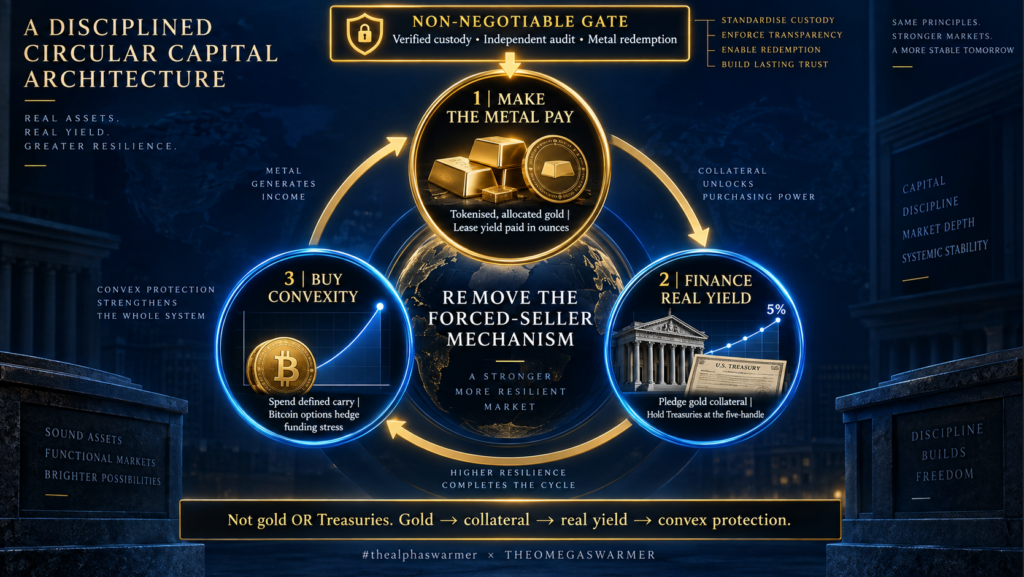
Leg 1 — Hold gold as tokenised, leased, allocated metal rather than as bullion or ETF units.
This answers the carry problem directly. A ~3.93% yield in ounces closes most of the gap to a 5.01% nominal Treasury and beats it outright in real terms. It converts the asset from immobile and non-yielding into income-producing and postable. Critically, it removes the forcing mechanism: a holder earning in metal is not compelled to sell into a reverse-carry margin cascade. It also gives you something a bar in a vault cannot — an ounce that can be pledged without being shipped.
Leg 2 — Use that metal as collateral against Treasuries at a five-handle.
This is the point the reserve-asset narrative was gesturing at without earning: if gold is genuinely collateral, then its function is to finance a position, not to be the position. You are not choosing gold or Treasuries. You are using the re-based, income-producing asset to term-finance the highest real risk-free rate in two decades. And 2.68% real is not a consolation prize; it is the best real yield the long end has offered since before the financial crisis. I have argued since January 2024, in The Demise of the US Dollar, that the Basel framework would have to evolve to let institutions “hold dynamic reserves of a myriad of assets that were previously not accepted into the mainstream.” Collateral eligibility was always the real battleground.
Leg 3 — Spend a defined slice of the carry on convexity, expressed in Bitcoin options.
This answers Proposition 1 as corrected. If the five-handle predicts drawdown rather than direction, the correct response is to remain invested and own convexity — and convexity is cheapest where implied volatility is depressed relative to the tail being insured. The note itself supplies the evidence that the market is not paying for protection: Nasdaq one-month put-call skew at zero, among the lowest readings in twenty years. I cannot independently verify that options-surface data from primary sources and I flag it as the report’s figure, not mine. But the structural logic does not depend on it: a reverse carry unwind is a funding event, and funding events transmit fastest and most violently to the longest-duration, highest-beta asset in the complex. That is Bitcoin. Defined-risk long optionality there is the most capital-efficient way to be paid for the precise scenario that would damage legs 1 and 2 — and the premium is funded from the carry those legs generate, not from selling them.
This is not a new idea of mine, and I say that only to establish it is a standing thesis rather than a reaction to a headline. On 19 June 2024 I wrote that Bitcoin “will play a role in tokenisation and RWA as well as hedging volatility through covered calls.” On 4 August 2024: “Options ETF can hedge volatility and keep unit costs relatively stable amidst the price gyrations the commodity exhibits.” On 5 August 2024, addressed to the Federal Reserve: “You then will tokenise treasuries and you will also implement the commodity bitcoin as a strategic reserve asset.” On 22 April 2025, on stablecoin regulation: it would “pave the path towards the tokenisation of treasury assets.” And on 24 July 2026, on how to express the rates view: “accumulating TLT gradually on weakness, using long-dated call options (LEAPS) if you want convex upside.”
The three legs were postulated separately across four years. The five-handle is simply the first moment at which the arithmetic makes them assemble into one position.
Where this fails
A thesis without falsification conditions is marketing. Here are mine, stated in advance:
- Custody failure. One significant tokenised-gold issuer failing an audit, or gating redemptions, ends this argument outright and deservedly. This is the largest risk and it is not diversifiable by holding more tokens.
- Scale. Tokenised gold is roughly $6 billion in market capitalisation. Central bank gold is around $5.1 trillion. The tokenised market is about one eight-hundred-and-fiftieth of official holdings. Quarterly spot volumes exceeding $90 billion show genuine velocity, but institutional-scale collateral use cannot be executed in a $6 billion market today. This is a direction of travel, not a position you can put size into this quarter.
- Lease-rate compression. The 3.93% is high by historical standards and reflects unusual industrial demand for borrowed metal. If it compresses toward 1%, Leg 1’s answer to the carry problem substantially weakens.
- Real yields keep rising. Since the slope is intact, a move to 3.5% real would hurt gold badly, lease yield or not. The structure mitigates the forced-sale mechanism; it does not immunise against mark-to-market.
- The quantity divergence resolves downward. If ETF ounces, official tonnage and valuation-adjusted reserve share continue to stall while price stalls too, then price was the story and the collateral narrative was always the alibi. I would want to see official purchases re-accelerate above 1,000 tonnes annualised before adding.
- Bitcoin decorrelates from funding stress. Leg 3 assumes Bitcoin remains the highest-beta expression of a liquidity event. If it behaves defensively in the next unwind, the hedge is mispriced and should be moved.
The finding
The witness is right that something has changed and wrong about what.
Gold’s reserve share rose because gold’s price rose — the ECB says so in its own report, two sentences after the line everyone quoted. Gold’s relationship to real yields did not break; it was at its tightest immediately after the seizure everyone credits with breaking it, and it is functioning this month. What actually changed is the level: gold was re-based upward by several multiples of what the old relationship implies, while remaining exactly as carry-sensitive as it ever was.
That combination is the whole problem. A re-based, fully carry-sensitive, non-yielding asset facing a 2.68% real risk-free rate is a position the market will keep selling first in every funding event — which is why the rotation reflex keeps working, and why it will work again when the reverse carry arrives.
The conventional escape is to sell the gold and hedge the equities. That surrenders the re-basing, which was the only part of the story that was ever real, in order to avoid a carry cost.
The alternative is to make the metal pay. Tokenised, verifiably custodied, leased allocated gold yielding in ounces is not a better narrative about gold. It is a different asset: one that generates income in the unit it is denominated in, can be pledged without being moved, and therefore removes the forced-sale mechanism that makes gold the first casualty of every margin event. From there it finances the best real Treasury yield in twenty years, and the carry buys convex protection against the one scenario that would break both legs.
It does not exempt you from the spot price. I have corrected myself on that above, and it matters. It exempts you from being forced to care about it on someone else’s schedule.
That is the whole edge. At a five-handle, in a reverse carry, the entire game is whether you are the one who has to sell.
Data as at 18 September 2026 (latest published FRED observations) and 22 September 2026 (gold). Primary sources: Federal Reserve Board H.15 via FRED (DGS10, DFII10, T10YIE); ECB, The international role of the euro, June 2026; gold futures settlement data. Correlation and regression workings are reproducible from the series named. Nothing here is financial advice; the positions described are analytical structures, not recommendations.
Related reading: The Prophecy, Continued · Hike It Double? · Metastasis of Economic Frameworks · The Demise of the US Dollar · The Adoption Frontier · Tokenisation