
In September 2022, I published a piece here called Retrospective Appreciations Of Various Literature and Appropriations, and buried inside it — as a plain PDF download most readers would have scrolled straight past — was an essay I wrote in 2013 comparing Peter Jackson’s Fellowship of the Ring against Margaret Atwood’s The Handmaid’s Tale, with a Keats poem stitched between them as connective tissue. At the time I filed it as an old piece of literary appreciation, worth resurfacing but not worth revisiting. I was wrong about the second part. A dream my cousin had about Pluto just forced me to reopen it, and the essay held up better than I expected: not as literary criticism, but as a working diagnostic.
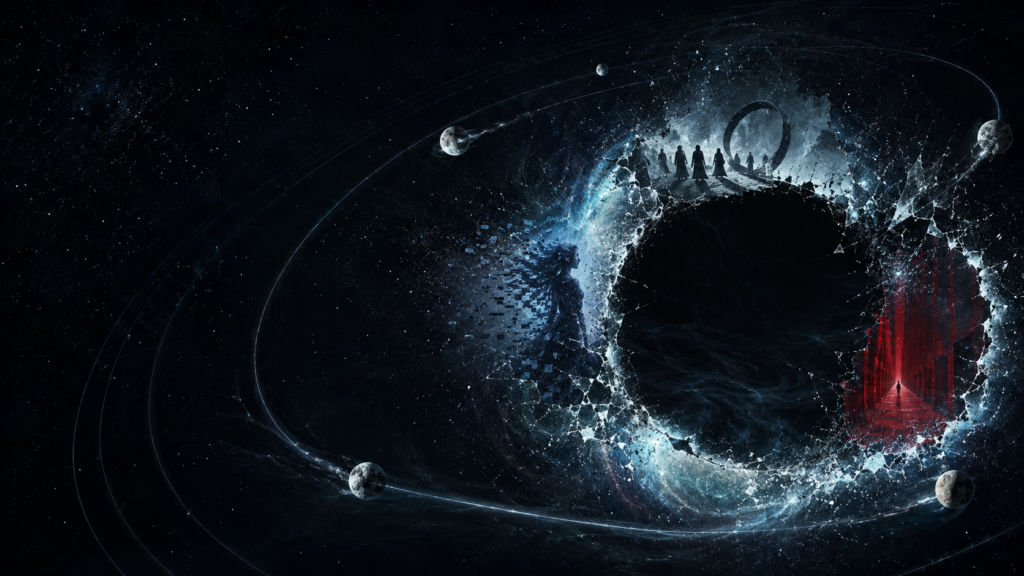
The dream itself is unremarkable as fact and useful as fiction. My cousin, who is fascinated with Pluto to the point of minor obsession, dreamed that it was consumed — erased entirely from the Solar System. It was not. NASA still tracks its orbit; it still has its five moons and its improbably large icy heart. But the dream supplied the one ingredient every piece of speculative fiction actually runs on: a single rule of the familiar world, altered, followed to its consequences. *What if Pluto disappeared?* is not a fact. It is a method — the same method my 2013 essay had already identified running underneath a hobbit’s ring, a knight’s fatal enchantment, and a totalitarian regime’s naming conventions.
The “What If” Is Not Whimsy — It Is Diagnostic
Speculative fiction gets filed, lazily, as escapism: spaceships, enchantresses, distant worlds. The 2013 essay’s actual claim was narrower and more useful.
It argued that texts in this genre take something familiar, alter one governing rule, and construct an alternate world whose internal mechanics still resonate with the reader’s own — so that the ideas inside the fiction remain locatable inside our collective experience once the fiction ends. The alternate world is not the point. It is the delivery mechanism. The genre exists to smuggle a real anxiety past the reader’s usual defenses by first disguising it as something that could not possibly be about them.
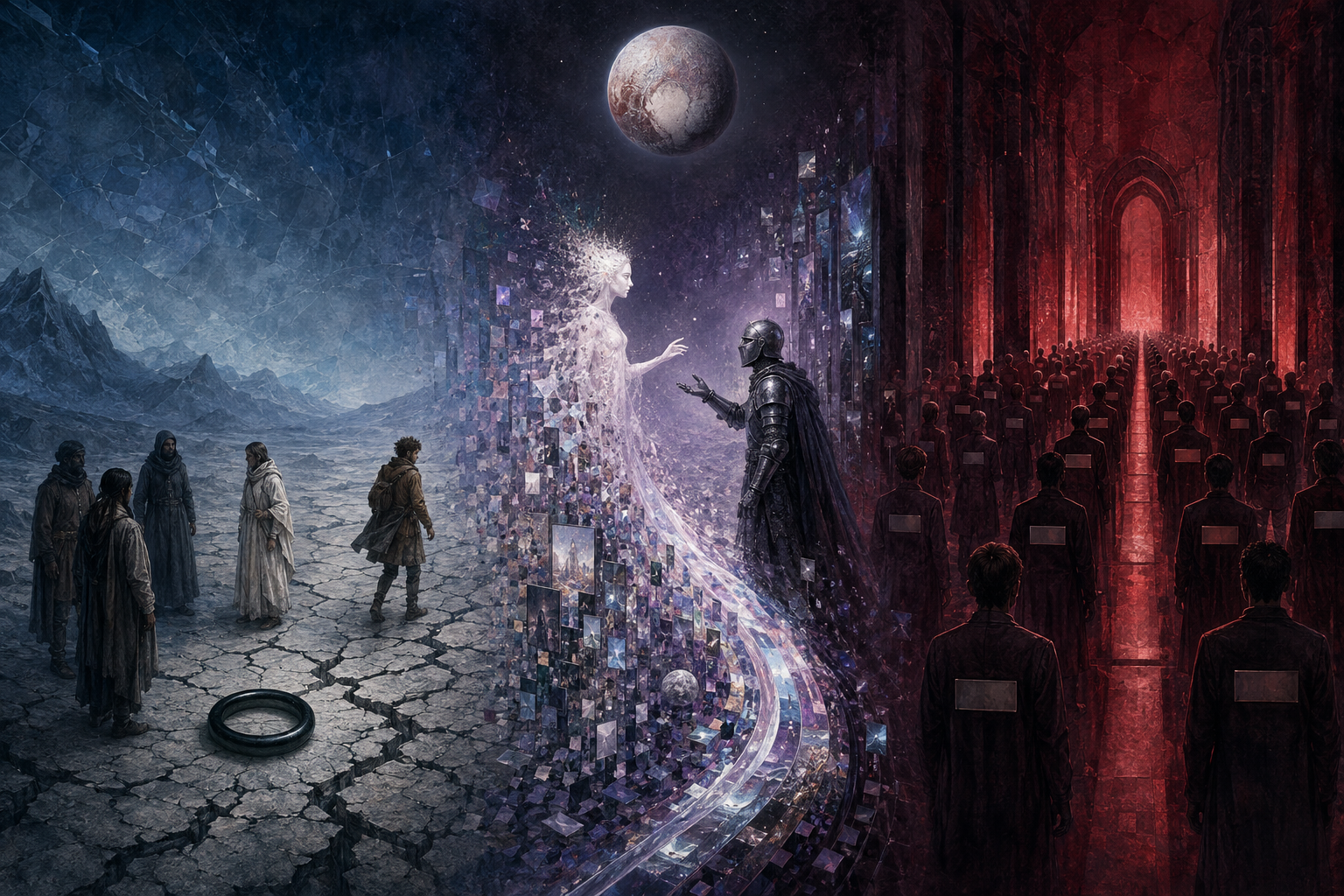
Which is why three unrelated texts — a Cold War-era fantasy epic, a Regency gothic ballad, and a 1985 dystopian novel — turn out, on the essay’s own reading, to be running the identical diagnostic against three different historical anxieties. Jackson’s Ring is the growth of unchecked power ideology metastasizing inside ordinary people. Keats’s enchantress is the seduction of appearance over substance. Atwood’s Gilead is the reversal of hard-won freedom, dressed as protection. Different costumes. One underlying paradigm, tested three times.
Middle-earth’s Actual Lesson Was Never the Ring — It Was the Fellowship’s Fracture Point
The Ring gets the attention because it is the object, but the essay’s sharper observation was about the Fellowship, not the Ring.
Sauron’s ring does not need to conquer nine armed and capable individuals by force. It only needs to divide them — surface Boromir’s rationalization that the Ring “could be used for good,” let Saruman conclude that resistance is impractical, and the fellowship dissolves itself without a single external blow landed. Frodo’s resistance is often read as the story’s moral center, but the essay’s more interesting claim is structural: the antagonist’s actual method is not power, it is division deployed before power is even required. Conquest is the second step. It is only ever necessary because the first step — division — already worked.
That is the throughline I had not fully connected until Pluto forced me back into the essay: Atwood’s Gilead runs the identical first step. A regime that renames men as Commanders, Angels, and Guardians while renaming women by their reproductive function — Wife, Martha, Handmaid — is not merely controlling language for its own sake. It is doing to women exactly what Sauron’s ring does to the Fellowship: separating them from each other, from continuity, from any collective identity not defined by their relation to a man, before a single overt act of physical control is required. Two texts, two genres, two centuries apart in setting, running the same opening move. The essay noted the parallel explicitly in 2013. I had filed it as a clever cross-reference. It is closer to a mechanism.
The Knight’s Fatal Error Has Become Everyone’s Default Setting
Keats’s contribution to the same diagnostic is smaller in scale and, thirteen years later, more relevant than either of the other two. The knight of La Belle Dame sans Merci is not defeated by strength. He is defeated by his inability to distinguish an enchanting appearance from an underlying reality — and the poem punishes this with total narrative severity, denying him even the genre’s usual courtesy of a redemptive ending. In 2013 that read as a period piece about gothic seduction. In 2026, in a landscape of curated identities, synthetic imagery, and information architecture explicitly engineered to be persuasive before it is examined, the knight’s fatal error is closer to a design specification than a warning. La Belle Dame would not need a hillside and an elfin grot today. A feed would do.
What Pluto’s Disappearance Would Actually Test
None of this required Pluto to be real. That is the entire operating principle the 2013 essay described and the 2022 post around it never quite named directly: speculative fiction’s value is not in the accuracy of its premise but in the honesty of its consequences!
If Pluto actually vanished tomorrow, the interesting question would not be the astrophysics. It would be behavioral. Would institutions disclose what they knew, or manage the disclosure? Would the reaction organize around evidence, or around whoever supplied the most comforting explanation fastest? Atwood’s Gilead and Jackson’s Fellowship already answered this at the level of fiction: division precedes control, and control is dressed as protection until the costume becomes unnecessary. A vanished Pluto would simply be the fourth test case — a smaller, purer thought experiment because nothing is actually at stake, which is precisely why it can be trusted to reveal something honest.
That is also, I think, the correction I owe to the 2022 framing. I described those old essays then as literature worth appreciating retrospectively. The more accurate description, arrived at only by being forced back into the material thirteen years later by an unrelated dream about a dwarf planet, is that they were never retrospective at all. They were a working diagnostic, filed under the wrong heading, waiting for a new test case to prove it still ran.
Pluto has not gone anywhere. But for the length of one dream and one essay reopened, it was useful precisely because it hadn’t — because removing something safely fictional is still the fastest way to see, with sharper eyes, what was actually holding the real thing in place.
*The original 2013 essay discussed here remains embedded as a PDF in [Retrospective Appreciations Of Various Literature and Appropriations](https://www.thealphaswarmer.com/2022/09/retrospective-appreciations-of-various-literature-and-appropriations-an-introspective-reflective-extrapolative-approach/) (2022).*