


Public argument about fathers tends to arrive in two unhelpful shapes. One asserts that fathers are essential in a way that implies mothers are insufficient — a claim the evidence does not support and which usually carries more ideology than data. The other treats fathers as functionally interchangeable with any other adult, a secondary caregiver whose involvement is pleasant but structurally optional. Both are wrong, and the space between them is where the actual research lives!
What follows is an attempt to state, as precisely as the evidence allows, what is known about paternal involvement in early childhood development — including where the findings are weaker than advocates claim, and where they are considerably stronger than sceptics assume.
What the evidence establishes
The most defensible summary is that father involvement is reliably associated with measurable differences in child outcomes, and that the association is real but moderate.
A 2026 three-level meta-analysis synthesising 37 studies and 249 effect sizes found a positive association between father involvement and children’s positive social behaviour (r = .203) and a smaller inverse association with negative social behaviour (r = −.087). The relationship was moderated by the child’s age, family socioeconomic status, the type of involvement, who reported it, cultural background and study quality. Notably, the child’s gender did not significantly moderate the effect — a finding worth sitting with, given how much popular commentary assumes fathers matter primarily for sons.
A separate meta-analytic literature on early social-emotional development reaches a consistent conclusion: consistent, responsive and supportive paternal involvement is associated with emotional regulation, social initiative, self-confidence and adaptive social interaction.
These are correlations of modest magnitude. They describe population tendencies, not individual destinies, and they cannot predict the trajectory of any particular child. But they are stable across large bodies of work, and an effect that survives that much aggregation is not nothing.
The distinctiveness question
A more contested claim is that fathers contribute something qualitatively distinct rather than simply providing a second dose of what mothers provide.
The honest position is that evidence points that way without having settled it. Research suggests paternal contributions differ in pattern from maternal ones and that some component may be unique rather than merely additive. The most studied candidate mechanism is physical, vigorous, unpredictable play — rough-and-tumble play — which in some samples predicts later language, cognition and literacy outcomes, and which appears to give children practice in negotiation, escalation and de-escalation, and the reading of non-verbal cues under arousal.
The mechanism is plausible: a form of interaction that repeatedly takes a child to the edge of over-arousal and back teaches emotional regulation in a way that calmer interaction does not. But this literature is smaller than the involvement literature, the measurement instruments are relatively new, and there is nothing biologically obligatory about which parent does it. The defensible claim is that this style of interaction matters and is more commonly supplied by fathers — not that only fathers can supply it.
The distinction that matters most: contact is not involvement
This is the single most important finding in the field, and it is routinely misused by people on both sides of the argument.
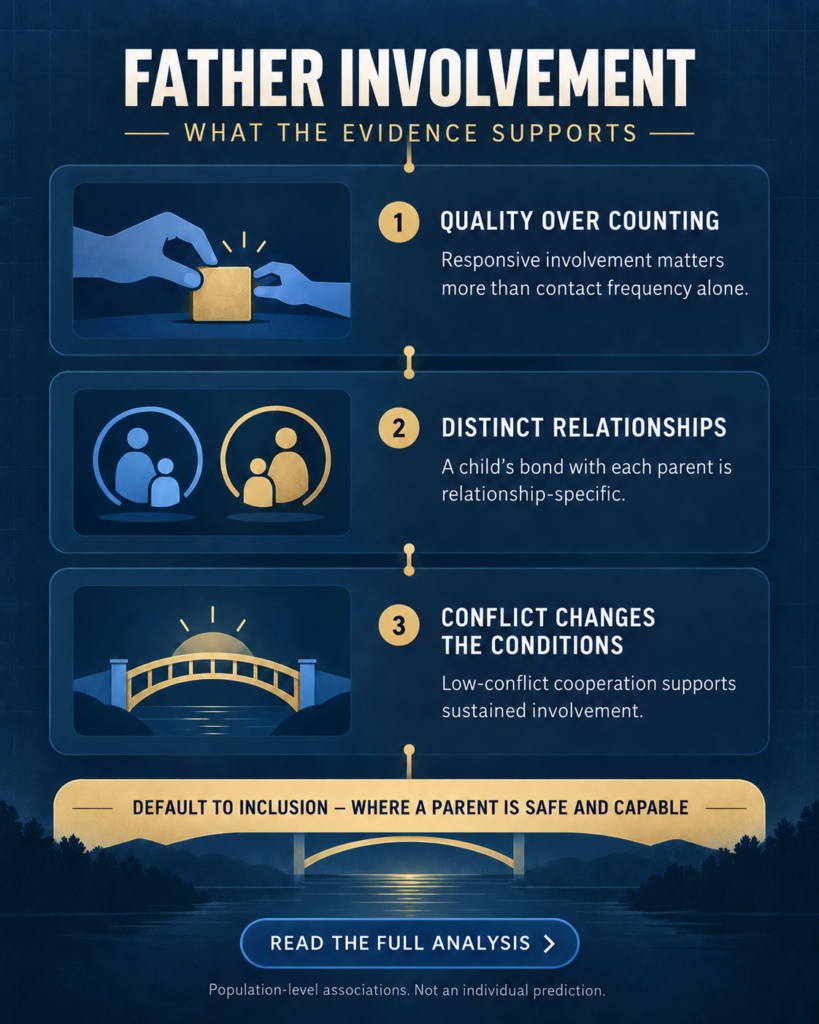
Two meta-analyses comparing the effect of face-to-face contact frequency against the quality of father involvement on children’s wellbeing found no association with contact frequency and a positive association with involvement. The conclusion drawn was direct: contact in itself is not sufficient to produce benefit for the child.
Both camps should find this uncomfortable. It undercuts any argument that counts hours as though time were the active ingredient. But it equally undercuts any position that treats reduced contact as costless, because involvement of the kind that does predict outcomes — responsive, engaged, knowing the child’s routines and friendships and fears — is not achievable at arbitrarily low levels of contact. Contact is a necessary condition for involvement without being a sufficient one.
The practical implication is that arrangements should be evaluated on whether they permit a relationship of real substance to exist, not on whether a quantity threshold has been met.
Early childhood as a period of consolidation
Why the early years attract particular attention is a question about developmental timing.
Golding and Fitzgerald’s 2019 work in the Infant Mental Health Journal argues that boys’ comparatively slower developmental timetable across the first years may increase vulnerability to disorganisation in the emergent neurobiological networks that organise socioemotional relationships, and that early caregiver abuse, neglect, father absence and exposure to violence compound risk for later aggression. This is a risk-pathway argument, not a prediction — and it is worth noting that the special issue it belongs to concerns the origins of violence in males, a framing that attracts strong claims and deserves careful reading.
The attachment literature supplies a more precise and, in some ways, more useful point. Work validating the Child Attachment Interview established that children can be classified differently with respect to each parent — securely attached to one, insecure or disorganised with the other. Attachment is not a single global property of a child. It is relationship-specific.
That finding matters here because it means a child’s secure relationship with one parent does not automatically substitute for a disrupted relationship with the other. The two are measured separately because they are, developmentally, separate.
What actually predicts whether fathers stay involved
Here the research becomes genuinely inconvenient for adversarial approaches to family separation — including adversarial approaches taken by fathers.
Longitudinal work following separated families finds that the quality of the co-parenting relationship — low conflict, high cooperation — predicts both the frequency of father-child contact and fathers’ involvement in activities with their children, with the effect most pronounced in the first year after separation. The association is bidirectional, but co-parenting quality predicts paternal involvement more strongly than the reverse.
Meanwhile, the meta-analytic literature on interparental conflict is unambiguous about its cost to children. A 2020 synthesis of 169 studies on child maladjustment and 61 on children’s responses to conflict found hostile conflict most strongly associated with externalising behaviour and emotional distress, with disengaged and unconstructive conflict carrying risk across other domains, and many associations persisting longitudinally.
Read together, these two bodies of work produce an uncomfortable conclusion: the conflict through which contact is often fought for is itself a mechanism of harm, and a predictor of reduced paternal involvement. A father who wins contact through sustained hostility may be damaging the conditions under which involvement actually becomes possible. This is not an argument for passivity. It is an argument for recognising that the relationship between the adults is a determinant of the relationship between father and child, not a separate matter.
The case for defaulting to inclusion
If the evidence is associational and the effects are moderate, why argue proactively for including fathers?
Because the question facing any system — a court, a service, a policy — is not whether father involvement guarantees a good outcome. It is how to act under uncertainty, and that turns on the asymmetry of the two possible errors.
Wrongly including a safe and capable father costs relatively little. Wrongly excluding one imposes a cost borne by the child, over years, and it compounds: relationships that lapse become harder to rebuild than relationships that are maintained, because involvement of the kind that predicts outcomes is built on accumulated familiarity — knowing the routines, the friendships, the current preoccupations — and that knowledge decays when contact becomes sparse.
Pruett, McIntosh and Kelly’s consensus work on separation and the care of young children, published across two parts in the Family Court Review in 2014, is notable precisely because it was produced by scholars who had publicly disagreed and who then set out to identify what the evidence would jointly support. Their framework places weight on maintaining children’s relationships with both parents while attending carefully to the developmental particularities of very young children — a position that treats continuity as valuable without pretending that any single arrangement suits every family.
The design principle that follows is modest and, I think, defensible: systems should default to inclusion where a parent is safe and capable, and require justification for exclusion rather than requiring a parent to justify inclusion. The safety qualifier is not decorative. Where there is family violence or genuine risk, the calculus changes entirely, and the same evidence base that supports involvement supports protection.
What this evidence cannot do
Several limits deserve stating plainly, because overreach in this area is common and it discredits the underlying case.
It cannot predict individual outcomes. Correlations of the magnitude reported describe distributions, not persons, and no responsible reading permits a claim about a specific child.
It cannot establish causation from most of the designs involved. Families in which fathers are highly involved differ systematically from families in which they are not — in income, stability, conflict, and much else — and statistical control is imperfect.
It cannot treat “father absence” as a single phenomenon. Bereavement, incarceration, labour migration, abandonment and court-ordered limitation are radically different circumstances that the literature has often pooled. Studies of migrant and left-behind families in particular — frequently cited in this debate — describe separations of years, in specific economic and cultural conditions, and generalise poorly.
And it cannot be used to argue that mothers are insufficient. Nothing in this evidence base supports that proposition, and any argument for fathers that depends on diminishing mothers is both empirically wrong and self-defeating.
Conclusion
The strongest defensible position is narrower than fathers’ advocates usually claim and considerably stronger than institutional practice has often assumed. Father involvement is associated with measurable benefits at moderate effect sizes. Quality of involvement, not volume of contact, is what carries the association — though involvement cannot be built without sufficient contact to sustain it. Attachment is relationship-specific, so one secure bond does not substitute for another. And the quality of the relationship between separated parents is among the better predictors of whether a father remains involved at all.
That last finding is the one most worth acting on, and the one most often ignored by everyone in the argument. The conditions under which fathers stay involved are not primarily legal. They are relational. Systems that reduce conflict, and adults who decline to escalate it, are doing more for the father-child relationship than any amount of contested contact.
This article discusses population-level research findings. It is not clinical, developmental or legal advice, and no finding discussed here can establish anything about an individual child or family.
References
- Li, Y., & Hao, J. (2026). Father Involvement and Children’s Social Behavior: A Three-Level Meta-Analysis. Behavioral Sciences, 16(8), 1426.
- Golding, P., & Fitzgerald, H. E. (2019). The early biopsychosocial development of boys and the origins of violence in males. Infant Mental Health Journal, 40, 5–22.
- Pruett, M. K., McIntosh, J. E., & Kelly, J. B. (2014). Parental Separation and Overnight Care of Young Children, Part I: Consensus Through Theoretical and Empirical Integration. Family Court Review, 52, 240–255.
- van Eldik, W. M., de Haan, A. D., Parry, L. Q., et al. (2020). The interparental relationship: Meta-analytic associations with children’s maladjustment and responses to interparental conflict. Psychological Bulletin, 146(7), 553–594.
- Shmueli-Goetz, Y., Target, M., Fonagy, P., & Datta, A. (2008). The Child Attachment Interview: A psychometric study of reliability and discriminant validity. Developmental Psychology, 44(4), 939–956.