
—
What I Wrote Then — 21 April 2011
The original piece, *Freedom of Speech in Network Economies — A Subjective Perspective*, wasn’t written as abstract theory. It was a reaction — same-day, same-morning — to a Sydney Morning Herald story about a Facebook Washington lobbyist worried the platform was allowing “too much, maybe, free speech.” That triggered a genuinely specific legal argument, not a vague one: Australia has no First Amendment equivalent, so free speech here gets balanced against competing interests case by case, and the most common transgression online is defamation.
I cited Kimberly Heitman’s 2005 UNSW Law Journal paper on a “micro-trend” she’d identified — plaintiff lawyers advising clients to sue the *Internet Service Provider* rather than engage the actual content creator — and connected it to the real case that had just gone the other way: iiNet’s court win, protected by the Broadcast Services Amendment (Online Services) Act 1999, which exempted ISPs from liability for content they didn’t monitor. I called the alternative — ISPs monitoring everything pre-emptively — a *Minority Report*-style system, and said so plainly.
Then, almost as an aside, 25-year-old me wrote this:
“All I can perhaps suggest subjectively is that everyone concerned… start looking into open-licensing deed systems… and try to shape an international framework that underpins the Creative Commons Deed Licensing System as a benchmark.”
That’s the sentence this article completes. It wasn’t a fully-formed philosophy in 2011 — it was a suggestion, thrown out at the end of a piece mostly about defamation law and ISP liability. I didn’t have the operating framework yet. I had the instinct.
What Evolved — 2011 to 2026
The internet that existed in 2011 was still, mostly, the internet the ISP-liability debate assumed: content sat somewhere, an ISP carried it, and the argument was about who was responsible if it caused harm. The internet that exists now doesn’t resemble that shape.
Platform concentration replaced distributed hosting. Algorithmic curation replaced chronological feeds. Screenshots, leaks, and frictionless copying made “containment” a fantasy long before AI made *synthesis* — not just copying, but recombination — trivial at scale. Remix culture stopped being a subculture and became the default mode of how ideas actually move.
None of that made the 2011 concern obsolete. It made the 2011 concern *incomplete*. The defamation-and-liability framing assumed the fight was about who gets blamed when something spreads. The real fight turned out to be broader: who gets *credited* when something spreads, and on what terms. The intervening fifteen years didn’t prove copyright irrelevant — they proved that the binary options available in 2011 (absolute enclosure, or uncontrolled appropriation) were never going to be adequate for a networked culture that was about to get radically more networked.
The Argument Now — 23 August 2026
Creative Commons is the operational bridge between the freedom I was defending in 2011 and the responsibility that framework needed all along.
Information will circulate. That was already true in 2011 — it’s just true faster now. But circulation is not permission to erase authorship. Leakage does not extinguish copyright, and public accessibility does not confer ownership. Attribution creates a traceable chain of intellectual custody — the same custody question that was really underneath the ISP-liability debate fifteen years ago, just pointed in the opposite direction: not “who’s liable for this,” but “whose work is this, really.”
**The DJ is still the right metaphor.** A DJ doesn’t create the drums, the vocal, or the bassline in any given track. The artistry is in selection, timing, transition, and the new experience built from existing recordings. That curatorial layer has real value — but it doesn’t cancel the rights attached to the original material. A remix is a layered work: the original creator retains rights in the original; the remixer may own genuinely original additions and arrangement; the licence governing the source remains relevant regardless of how far the remix travels.
That’s also the line between real transformation and cosmetic copying. Downloading someone’s work, changing the colours, adding a logo, and republishing it is not a remix. Attribution satisfies a licence condition — it doesn’t retroactively make an unauthorised use permitted. A real remix adds intellectual labour: original analysis, a new framework built from multiple properly-licensed sources, a genuinely new structure. The remix should contain the remixer’s mind, not just the remixer’s watermark.
**And Creative Commons is not “no copyright.”** It operates *through* copyright — the creator retains it, and grants specified permissions in advance. Under **CC BY-NC 4.0** specifically: sharing and adaptation are generally permitted for non-commercial purposes, provided you give appropriate credit, link to the licence, and indicate whether changes were made. “Non-commercial” is a real restriction, not decoration. Commercial use needs separate permission.
My Position, Fifteen Years On
Where my content is licensed under **Creative Commons Attribution-NonCommercial 4.0 International**, you’re welcome to share and adapt it for non-commercial purposes, provided that you:
– Attribute **Mohit (Max) Bhanabhai** and **thealphaswarmer.com**.
– Link to the original work wherever reasonably possible.
– Identify the **CC BY-NC 4.0** licence.
– Clearly state whether you edited, excerpted, translated, or adapted the material.
– Don’t imply I endorse your adaptation, organisation, product, or conclusions.
– Don’t impose additional restrictions inconsistent with the licence.
– Seek separate written permission for commercial use.
Take the idea forward. Debate it. Build on it. Combine it with your own analysis. But don’t take the source, erase the trail, and present the result as though it arrived from nowhere.
The 2011 version of me suggested this as a benchmark worth looking into. This is what looking into it, properly, for fifteen years, actually produces.
—
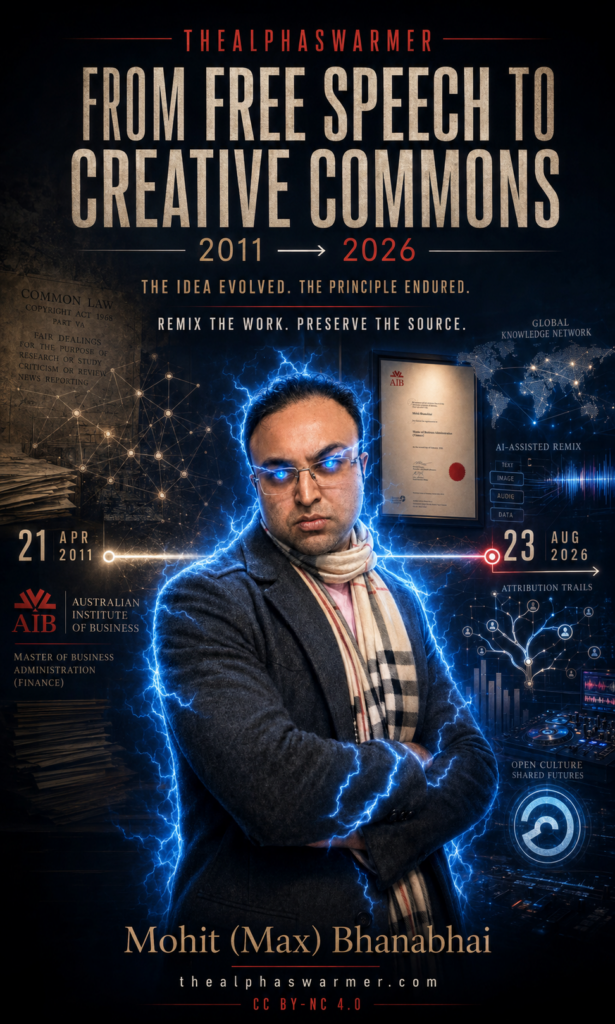
Chronology
– **21 April 2011, 6:46 AM** — original article published; suggests Creative Commons as a benchmark, in passing, at the end of a piece about defamation and ISP liability.
– **2011–2026** — the open web became increasingly platform-mediated, algorithmically curated, frictionlessly replicable, and AI-assisted.
– **23 August 2026, 11:38 AM AEST** — the suggestion formalised into an actual operating licence and philosophy.
—
© 2018–2026 Mohit (Max) Bhanabhai / thealphaswarmer.com. Except where otherwise stated, designated content is licensed under the Creative Commons Attribution-NonCommercial 4.0 International licence. You may share and adapt the designated material for non-commercial purposes with appropriate attribution, a link to the licence, and an indication of changes. Third-party material remains subject to its own copyright and licensing conditions.